- Generative AI as a potentially purer form of the capture of human genius than writing itself
What is the purest form of Chopin’s genius? There are a few levels.
Level 1: Chopin improvising live
Well, max-Chopin was surely to watch him improvise live, which he did with extraordinary style in among other places Parisian salons. It’s said that after a great session he’d hurry home to write down and preserve the outpourings of genius. Surely the purest experience of listening to Chopin would have been at one such salon:

Level 2: Chopin performing something he’s written down
The next level of Chopin would have been to listen to him play a piece, such as the Fantasie Impromptu, as a performance at some later point. Here the original moment of genius would have been mediated by the act of writing it down, and re-performing it. But you’d still be in the company of Chopin playing Chopin.
Level 3: someone else playing what Chopin wrote down
And the next level of pure exposure to Chopin would be to hear another person play one of his pieces, mediated by both the externalisation of writing (presumably a very lossy process, losing so much of the originary genius) and yet very good- I once saw Michail Pletnev play Chopin in Milan and it still seemed very Chopin like.
Digression on the weirdness of writing:
It is difficult to connect today to how unnatural and strange the possibility of capturing musical or any other genius in the form of written marks on a page is. We know that Socrates deplored writing, as recorded in Plato’s (ahem, written) remarks in the Phaedrus dialogue:
“”For this invention will produce forgetfulness in the minds of those who learn to use it, because they will not practice their memory. Their trust in writing, produced by external characters which are no part of themselves, will discourage the use of their own memory within them. You have invented an elixir not of memory, but of reminding; and you offer your pupils the appearance of wisdom, not true wisdom, for they will read many things without instruction and will therefore seem [275b] to know many things, when they are for the most part ignorant and hard to get along with, since they are not wise, but only appear wise.”
Level 4: a recording of someone else playing what Chopin wrote down
The next level after this is of direct access to Chopin is to listen to a recording of someone playing Chopin. Here the original genius of Chopin improvising has had to go via a) Chopin writing it down to b) Another musician interpreting those marks to c) a recording device reproducing those sounds.
Level 5: the digital invention of a recording of someone else playing what Chopin might have written down
Generative AI provides a fourth way in which Chopin’s genius can be passed through to us. Have a giant neural network memorise all the music ever. Have it pay particular attention to all of Chopin’s work. Prompt it to “Remember” Or “Improvise” Or “create” on the basis of this distilled remembrance of all of Chopin.
In some sense you can see that this is on a continuum with writing. An alien technology that can capture the essence of a human’s ingenious mind and feeling and transport it through time.
Final thought
These five levels aren’t really in sequence. There’s an argument to be made that the ultimate version of gen-AI (which would also immerse itself in Chopin’s letters etc) would actually be the closest to the experience of Chopin improvising as in Level 1.
It seems to me that this has implications for copyright, among other things. I”ll be happy for the superseding of reading / writing on which I”m largely in agreement with Socrates. Nobody I know imprints more than a fraction of a percentage of the books they read on their souls.
- Studs Terkel and the magic of reading
I first encountered the literary genre of the oral history at the same time I caught sight of probably its most masterful exponent, Studs Terkel. I was leafing around a book shop on the upper east side of NYC in Jaunary 2008, on my way to Obama’s Inauguration. I was leafing around some forgotten section of the store when the staff began to clear the room to ready it for a talk by the curiously named author of dozens of volumes of oral history, Studs Terkel. An energetic and diverse crowd flooded in, elated at the chance to meet someone they evidently held in highest regard. And then there was the man himself, seemingly 90 years old, wiry, alert and with a gaze of the most strikingly generous curiosity. I’d never heard of Studs Terkel, and, lacking a ticket I couldn’t stay, but I did pick up a copy of one of his books ‘Working” on my way out.
I’ve regretted not having had the chance to see his talk ever since (he would die 8 months later) and on the subway returning home as I began to read the book, I walked into a way of perceiving and reporting on the world of such generosity and richness of colour and anecdote that it made most novels and all non-fiction seem grey by comparison.
In Working, (subtitle: ‘People talk about what they do all, and how they feel about what they do’) Terkel recounts the stories of people in almost every imaginable profession of the time – pizza delivery guys, judges, programmers, lawn-mowers, prostitutes, politicians, doctors… and the accounts are so intimate and rich in detail that one almost feels as if one has worked in these professions oneself for a year or two. One feels them in one’s bones, from the interior subjective view. It’s really a very amazing piece of literature, whose power is that the author is a skilful conduit of every day lived experience. The charmingness of the book is deepened by the amazing similarity along certain dimensions of all of these accounts: every person, it turns out, has their dreams, sources of pride, rivalries,
I’ve been mulling a lot on reading and writing and its very non-linear benefits to the imagination and soul, and a couple days ago I picked up another of his books “Hard Times” – oral histories of people who lived through the Great Depression. Again, on almost every page one is delighted by a detail of life and given a fresh perspective on human lives, resilience, and meaning.
I’ll share some details from just on of the hundreds of oral histories in the volume. It’s the Terkel’s account of a worker in a Cuban cigar factory in the south, their strikes, lifestyle and so on. This four-page account is replete with wonderful detail: of how the workers, arrayed around tables hand-assembling cigars for 10 hours a day, would hire young people to read for them from a book all day long; choice of book was hotly debated, the readers (paid a minute fee) really hot into acting the books out, and how these illiterate depression-era workers had great knowledge of the great works of literature from Tolstoy, Stendhal, Goethe, Dostoyevsky and so on. The cigar make remarked that ever since he’d detested the phrase ‘working class’, for how condescending and misleading it was, in that these were some of the most educated people he would ever meet.
Another illuminating detail: workers would routinely give 10% of their minimal earnings to “the Spanish cause” such was the feeling of allegiance between this community and the Spanish. They’d sing Italian revolutionary songs together with Spanish words, not realising the origin, dreaming of communist revolution.
And another: On pay day, if anyone in the community needed help a hat would go round and everyone would chip in (‘such-and-such’s dad is ill, needs surgery… “the good thing was you never needed to ask yourself, someone else would have an eye out and make sure to suggest it”.
There are a few other details that stayed with me.
It took me 10 minutes to read the account, less time than it has taken me to write this. Yet this whole collection of fun anecdotes has followed me round these last days and animated my perception of the world in perhaps half a dozen moments. The funniest was when I visited the annual festival of the local eco-commune and witnessed a moment where they were singing a revolutionary song in Spanish. The romance of such song persists!
And the snakes and ladders of cultural progress really came through to me thinking about those young readers employed by . Today, we go to book clubs to create shared context for discussion; we generally listen to our audio books solo and rarely have a chance to digest them in conversation with others; everything feels free, and that diminishes the intentionality of our attention; the voice we might listen to is an actor’s or the author’s, and the personal connection and opportunity for learning provided for the reader are gone. I’d love a life where I could listen to the novels of Tolstoy with my community from a young person whose confidence and connection and literary skill were enhanced by the experience.
And all of this is of course an advert for the joys of reading: and how always unexpectedly it makes our minds richer and conjures useful connections and sensibilities in our souls.
- Agency and Consciousness in the Sonic Sphere
This post is a birthday gift for Matt Mullenweg, who just turned 40, and modestly request blog posts as gifts. Matt cofounded WordPress, on which this blog is written; he’s been a wonderful conversational partner on topics of consciousness over the years; and he is also one of the chief sponsors and enthusiasts for Sonic Sphere, one of the topics of the below.
Happy Birthday, Matt, and may your second quartet of decades exceed the first in substance, style and serenity.
——–
A treasured early experience from my twenties was being a member of Kevin O’Regan‘s extraordinary laboratory of consciousness in Paris. I’ve ever since aspired to being in an atmosphere of such undiluted creative boldness: a place where passion, ideas, and agency thrive in unfettered flourishing.
It was formative intellectually and personally, and also for the inspirational example it provided for how a culture and way of working can animate and enhance the work being done when they are harmoniously attuned (in this case, by the central theme of agency). I’ve tried ever since to nurture teams to work with a comparable level of inventive joy, with elusive results.
I was mulling earlier today the internal connection between the highly agential culture of that lab and the chief topic we were investigating (the role of action in constituting consciousness). And I was struck by the thought that it surely wasn’t a coincidence that the message and the medium were in such harmonious alignment.
And that thought in turn has gotten me thinking about what we’re up to at Sonic Sphere, the culture of the team we’re growing, and the invention that we’re attempting to bring to the world: one that helps people experience richer horizons of conscious experience. Given the constitutive role of agency in consciousness, it even has me thinking that we need to give as much emphasis to interaction as to light and sound in our iteratively evolving invention- about which, more below.
So in the weave of these ideas, let me try to identify some patterns.
The O’Regan lab
For those who don’t know him, O’Regan is a physicist-turned-psychologist-turned-philosopher (gradually climbing the tree of intellectual heroism) who published in 2001 a theory of consciousness so good that when I first read it I became breathless with a kind of ecstatic intellectual eros.
The theory seeks to resolve what is often (pompously) declared to be the greatest unresolved mystery in human affairs, namely the ‘Hard Problem of Consciousness‘, i.e. why we have subjective experience.
The Hard Problem is always articulated with reference to the mysteriousness of secondary qualities (colours, smells etc), and it is in the explanation of these that the sensorimotor theory changes the game.
The thing to be explained is first of all the qualitative differences between modalities: the redness of red, the ineffable subjective feeling of the smell of a rose, why the texture of sand-paper is so different in quality from the taste of cheddar etc etc. Equally, differences the kinds of experiences these modalities individually produce (redness vs roundness in vision, for example) is the object of inquiry.
The sensorimotor theory explains these differences in startling simple terms, by proposing that can be read off from the different ‘sensorimotor contingencies’ that the embodied functionality of those modalities imply: the different patterns of movement they permit, and how that movement invokes further sensory stimulation, and how implicit knowledge of those dependencies between movement and the feedback from that movement sculpt shapes through time that can, perhaps, give us a fecund view of the qualities of our various modes of experience.
A simple example of sensorimotor contingencies (for context)
The simplest experimental example to get one’s head around the concept of a sensorimotor contingency can be found in experiments done by the great psychologist Paul Bach-Y-Rita, inventor of the world’s first sensory substitution device, called a Tactile-Visual-Substitution-System (or TVSS).
The purpose of the device in question was to translate visual information into tactile information. The (blind) subject would wear a pair of glasses with a camera attached. That camera would translate its visual images to a pad of 100 * 100 vibrating pins, which recreated in real time a tactile ‘picture’ in patterned vibration. A bright object in the middle of the visual field would, for example, produce a strong vibration in the middle of the pad. If the light were top left, that’s where on the tactile pad the vibration would be strongest too. Thus, the TVSS device would manifest roughly the same info that is normally found in vision onto the skin.

It turned out in the course of these experiments that subjects could gain a strikingly compelling sense of vision through touch.
The critical observation Bach-Y-Rita made, however, was that the tactile information alone was useless to participants if they didn’t control the camera. When someone else controlled the camera, no matter how much time was spent, it was impossible to gain any purchase on the meaning of the tactile input, which was experienced as a kind of random pattering.
But when subjects did control the camera (i.e. when it was mounted on their glasses and they could freely move their head and body) they were able to make sense of the stimulation. A bright object in the centre of the perceptual field would swing left on the tactile image as they moved their head to the right, and vice-versas. Subjects found that after a developmental process of thousands of movements, and the learning of the sensory consequences of those movements, that the tactile information began to gain meaning and form, and that a distinctively 3-D feeling for the world would emerge- within hours of first donning the device.
Soon subjects would forget that touch would from the pad was touch at all. Instead, the sense of a world of tables, walls, people, depth would emerge in their experience, their consciousness. A distinctively visual qualitative experience- but deriving through the body.
What accounts for the visual feel of the experience? Not visual the cells in the retina, nor visual cortical brain regions (neither of which is involved) and not of course the raw form of the input (which is tactile). Instead what is common between a distinctively visual experience of the world in the TVSS and the normal sighted experience, is instead the structure of the underling patterns of interaction, and the subject’s mastery/implicit knowledge thereof.
The lessons even from this one example go wide and deep, but the fundamental one is that input alone is not information by itself. The meaning of the input has to be constrained by its context in a sensorimotor nexus. Up, down, left, right, near, far, these are concepts that are only given reality in human perception when integrated into a sensorimotor nexus. We take them for granted when we think about vision, but we do so at our intellectual peril when we forget the developmental sensorimotor process that determines the code for such input.
The same conclusion can be reached also from first principles (for all information requires a code), and it is this: that the fundamental unit of perception isn’t sensory, it is sensorimotor: input is infinitely ambiguous until contextualised against the dependencies of action, and active interaction is necessary to decode energy and turn it into information.
It is difficult to overstate how profoundly this simple idea shapes one’s thinking on the nature of perception, memory, consciousness, and our human relation to our physical embodiment. It truly calls for a paradigm- shift, a new way of organising the world, a simple thought shift after which nothing looks the same.
And the fun thing about this insight (in 2005, and indeed today) is that it is simultaneously obviously correct and woefully underspecified. It opens doors to an incomparably richer intellectual engagement to the nature of consciousness than the then-and-now dominant dualistic information-processing metaphors, but at the same time a thousand questions remain(ed): what exactly are colour, space, smell, texture, taste, memory? How to formalise a philosophy and science of mind were the fundamental grounding was not an internal state (some neurons lighting up, a ‘representation’ of the world) but an attunement to or implicit knowledge of patterns of interaction?
And it was within these wide open fields of intellectual possibility that a ragtag crew of brilliant young scientists had come to roam. And they found an intellectual atmosphere of great freedom and agency.
O’Regan’s Laboratory of consciousness
Kevin O’Regan, running the lab, had many intellectual virtues, chief among which was to embody (as he does even now at the age of nearly 80) a child-like open-mindedness constrained by a purity of intuition for rich explanation.

I recall relating to him that I had been disappointed by Bergson’s Matter and Memory because Bergson seemed to think that memory existed outside of the head. Kevin reproached me for my closed-mindedness, ready as he always was to approach a radical idea with total receptivity.
Meanwhile, there were perhaps a dozen grad students wandering around the lab, each of whom was boldly exploring the consequences of the theory in some fun direction. Collectively, they were the actors in a kind of utopian
Some anecdotes to illustrate the vibe of the place.
Aline Bompas, pictured below, spent a year wearing specially created sunglasses that were yellow on one side and blue on the other. Her aim was to investigate if the adaptation that would inevitable take place (the eye learning in essence to discount the colour bias) was motor-dependent, i.e. when she made eye movements after finally removing the glasses, would the world turn blue when she looked right, and yellow when she looked left?

The there was David Philipona, an ingenious mathematician, playing with Sony’s AIBO robot and programming it to follow the path of maximum learning in the uncovering of sensorimotor contingencies. The little robot dog would from the outside look like it was expressing curiosity and boredom as it played with an object for a while before apparently losing interest and clumsily pootling off to the next object of examination. A startling evocation of animal-esque subjective experience in a simple robot (in 2005!).
Conversation would turn to how a neuron knows it is a sensory vs a motor neuron (it doesn’t, without sensiorimotor context) and the kinds of algorithm that the brain needs to ‘discover’ the dimensionality of the world, the difference between sensory and effector, the distinction between modalities. The answers are worth a read. (And it is interesting to note that in contemporary machine learning and robotics, companies like Tesla and Wayve have finally discovered that architectures that combine perception and action integrally are the path to successful real world agency).
My own research was on creating illusory pain and out of body experiences (using variants of the rubber hand illusion) and led to some memorable scenes, including successfully making a series of young students experience their bodies as being 1/10th their actual size, and the world correspondingly immense.
And meanwhile, there was a brilliant Canadian neuroscientist, Paul Reeve, as welcome as anyone else in the lab, who thought this was all nonsense and with whom we spent endless hours defending and honing the ideas and dreams of the theory.
The whole place had the feeling of a conclave of mad scientists, where no question was out of bounds.
If I try to summarise the conditions under which this explosion of creativity emerged, I might identify three factors:
- A wide-open horizon of discovery
The first reason the creativity was so exotic was that a new theory had opened up a new way of thinking, and thus there was a wide field of discovery lade bare before us: lots to do.
Part of the reason that the vibe was so good was how obvious it was that we were on a path to truth, and how little this was recognised by the broader academic community (who were stuck at the time, and continue to be unaccountably muddied by, the endless seductions of dualism and the mereological falacy).
It’s fun being right when outsiders don’t get it: both because of the camaraderie, and because it feels more playful, collaborative and peaceful to be simply after the truth than competing for dominance (in business or
2. A diversity of personal and intellectual styles
The lab was extremely diverse, in terms of gender, race, and intellectual specificity. Neuroscientists, cognitive scientists, mathematicians, roboticians, physicists, philosophers all bustled and argued and invented.
Research output included mathematical proofs, cognitive and behavioural experiments, philosophical thought experiments.
It’s almost a cliché to praise diversity, for it is so obviously productive and just and in the service of genius; yet it remains startlingly rare to find it truly expressed in the service of effective worldly action.
3. A virtuous balance between centralised / decentralised
The lab was centralised (under Kevin) but decentralised in the sense that everyone was free to pursue their intuition, to get into the swing of their own agency, and to pursue whatever passionate idea attracted them in the context.
From this example alone, one might take the distilled ingredients of a context capable of maximising intellectual agency, as these three:
- Rich possibility (animated by pursuit of a secret truth)
- Diversity of participants
- Balanced decentralisation
One can see that all three of these factors were in the service of enhaced agency: rich open fields of possibility animated motivated effort and playful exploration; a diversity of participants ensured constant exposure to new methods of though and action, new ideas and perspectives; and the autonomy of the participants in a balanced decentralised system meant that everyone could do their own thing, express their particular genius, while individual discoveries and ideas super-additively inspired and amplified the other pathways.
In this way, the lab was an ‘engine of consciousness’ devoted to the study of consciousness: a place where individuals could expand their minds in pursuit of truth, and perhaps this was somehow connected to the underlying thought-space, where we were all hyper-attuned to the neglected role of action in the constitution of consciousness.
Sonic Sphere

So right now I’m busy with a gloriously ragtag bag of inventors building out the Sonic Sphere concept, which aims to be an engine and indeed a laboratory of consciousness. I’m keen to apply my learnings from Kevin’s lab, and indeed the project is infused with a connected energy.
The basic idea of the sonic sphere is that it is a spherical concert hall / media plane, in which the audience lies surrounded on all sides by light and sound, which can be sculpted into wholly new architectures.
The original vision was by Stockhausen, from 1970, and we’ve been iteratively developing the concept for the last three years. In doing so, we’ve done our best to establish the conditions of maximal agency in the team.
Agency in the Team
Here a similar trio of agency-enhancing factors are in play, as were in O’Regan’s lab.
- Rich possibility (animated by pursuit of a secret truth)
The goal is inherently very rich, since -with the possible exception of certain nightclubs- spaces of public gathering have fallen far behind the digital technologies which collectively shape our imaginations.
The invention of a digitally-native audiovisual concert hall in which the audience is truly immersed not just 360 (which is just a 2-D concept) but 360/360 opens up almost immediately a treasure-trove of interesting possibilities.
Now the complete spherical audiovisual media plane is already an extraordinarily high-impact stimulating device. And with the audience in an essentially directionless sphere of stimulation, in which every aspect of the audiovisual environment can be sculpted in the service of new experience, a whole new world of possibilities obtains.
For almost twenty years, people have been experimenting with spherical media formats, and of course Stockhausen’s original Kugelauditorium dates from 1970, so the ideas are by no means entirely new. Yet we’re still clearly incredibly early in unlocking the potentialities of such immersive media, and it’s not an exaggeration to say that almost everything remains to be discovered. We stand on the brink of a positive explosion of technique and knowledge in the service of creating new spaces of consciousness.
2. Diversity of participants
In building a machine that has architectural, structural, visual, auditory, software, experience-design, musical, sound-design, a team of dazzling diversity has -almost entirely on a volunteer basis- been attracted to the project.
To mention but a few of our team / collaborators:
- Jessica Lair, an American opera-singer turned software developer
- Nicholas Christie- a structural engineer whose past work includes designing the kinetic aspects of the world’s biggest Ferriss Wheel
- Merijn Royaards- a Dutch musician / sound artist / architect / philosopher whose PhD studied the connections between the Russian Avant Garde’s experiments in sound and light and those of the 1980s rave scene.
- Alex Bondarenko, Stephane Lee, Rob Rowland, three dazzlingly gifted structural / electronic / mechanical / software engineers who build autonomous electric flying cars in their day job
- Chris LeJeune, a pioneer of spherical video.
- Andrew Melchior, once CTO for Massive Attack
- Patrick Rowland, a 24 year old electrician from Toronto.
- Uniiqu3, the Jersey Club Queen who made epic 3D music in NYC
- Rachel Harris, who created an extraordinary set of light cloths for our NYC sphere
- Madame Gandhi, a pop star who builds her own underwater microphones and has created epic arctic soundscapes for the sphere.
- Fatemeh Miri, a software developer who led our entire lighting system design / build / configuration / programming in NYC
- Mark Slee (the author of an incredible LED-lighting rig)
- Jeremy Guillory, an autonomous vehicle inventor and entrepreneur.
And while the intellectual and practical and geographical diversity here is inspiring, it can be substantially enhanced in time!
3. Balanced decentralisation
Given the need for so much excellence, it is quite easy for many parallel furrows of genius to be ploughed all while the fact of sharing the same field to force collaboration and mutual challenge.
For the London sphere we’re plotting, we’re simultaneously innovating the architecture, structure, speaker arrangements, spherical screen, and content. Each is an independent path, and at the same time each must interact with and take inspiration from the others.
So the conditions are well set for a good balance between a singular centralised vision, and a lot of opportunity for autonomous invention.
Audience agency inside the sphere
Our aim is to pioneer a new space, a kind of ultimate ‘engine of consciousness’.
By dint of unerring commitment to a full spherical media plane, we have in some sense a mathematically unbeatable complete immersion in sound and light… for what is more immersive than a sphere? With skilled sound engineering, robust audiovisual correlations, ingenious art, this alone creates a platform through which artists and musicians can surely vehicle audiences to new spaces of consciousness.
But this much could just be passive, receptive. And we know that only by invoking the agency of an audience can the deepest results be achieved. And so the question of agency for the audience while having the experience of being in the sphere, naturally becomes a massive point of research for us.
For we know that the story of enlivened consciousness goes far deeper than the act of mere provocation by a stimulus, no matter how awesome and sophisticated it may be.
Indeed, according to the insights of sensorimotor theory, perceptual input is merely a prompt for the evocation of imagination / the activation of a rich set of expectations, the conjuring of a world of expectation. That is not to say the stimulus isn’t important, for the mere application of sound and light can produce exotic effects (cf the history of cinema), but by itself sound and light at greater levels of immersion are just more and better of the same, and inherently limited in their power.
This insight is the (correct, in my view) critique of related efforts to our Sonic Sphere, such as the MSG sphere in Vegas: that it just creates another, bigger, more dazzling, screen. That it therefore reproduces a distinctively masculine and dominant perspective on the world, imperial vs interactive, and that the docile audience with their phones out to record the experience are not as close to the richest pastures of their own experience as they could certainly be.
So if our intention is truly to propose a revolutionary engine of consciousness, there must be inherent space for agency in the experience of the art within. How will this manifest in our spheres?
The agency of audio
The first thing to say is that audition inherently leaves much more space for the imagination (a continuous, integral part of all perception, even in ants) to lean into than vision, due to its lower spatial precision, more qualitative relationship to reality, and the fact that sounds do not occlude each other, so sonic spaces are capable of being dramatically more layered and impressionistic than visual ones, which have the habit of reproducing the superficially cartesian space of environments.
In this way, leading with audio is already a choice for agency, since the roving imagination can project into and situate itself within already far more advanced spaces of meaning than it is easy to convey by visual means.
The direct perception of artistic agency
One mode of experience of agency is that borrowed by the audience from direct perception of a performer. When you’re watching a live performer (whether dancer, singer, DJ, pianist) you often directly experience the miracle of their inventive genius as if it were flowing free from your own soul. This is why cellists are so sexy. There is some quality of mirror-neuron-ish empathetic alignment with a live performer that, despite the fact the audience is just sitting in a chair, gives an experience of agency.
Internal architecture
Clambering across nets, and having a surface amenable to moving, dancing, interacting already transforms a space helpfully in the direction of supporting active inhabitation by its audiences.
Our direction of travel, then, is towards no fixed seating, complete internal reconfigurability and a floor that invites movement. This alongside a culture of participation, will doubtless convey us in interesting directions.
Audience Participation in the art itself
One of the finest and most interesting events at our experimental sessions at The Shed in NYC was an interactive choral experience led by the composer Rolfe Kent.
Rolfe led 200 people in a choral round, as they also moved through the space, and as their voices were projected back in three dimensions. It was an experience of startling depth.
The first example of participation when it comes to music is of course dancing, and that is one reason why nightclubs have for decades been the most interesting zones of experience and innovation in public space.
Audiovisual Interactivity
A very simple form of interactivity in Sonic Sphere is the application of a digital echo. If you’re in, say, a rendering of Chartres Cathedral and your shouts or footsteps echo back at you as if the sound has vehicled its way around the vast stone structure with 3second reverb, there is an unmissable amplification of reality: this is no longer a mere sensory stimulus, but a sensorimotor one.
But one can imagine the interactivity going much further. Thinking back to the experiments of the Russian avant-garde, take the Terpistone: an instrument that directly
Massively multiplayer interactivity
This is perhaps where things will really get going, when a multitude of audience members co-participate in the evocation of rich states of consciousness.
We already have a fantastic example of this in contemporary culture: the club dance floor. A dancefloor at a rave is an example of how light, sound, and movement combine to create exotic architectures of consciousness by means of collective action.
The synchronous movements, flashes, and beats create a participatively sustained experiential space of consciousness within which (sometimes absurdly peaceful) meanings can be collectively sculpted. Without the movement, the cogency and clarity of the space of shared perception would be impossible to attain, and out with that would go the meaning too.
So with this we already have a concrete example of how a massively multiplayer interactive audiovisual consciousness-engine works. A parallel example it might be worth keeping in mind is the experience of singing in a choir: where the action (singing- altering the tones emitted from the voice) is in a non-euclidean space of harmony defined by the other voices, and the experience of the beauty of the art is amplified internally by the act of participation compared to merely listening. And of course, the evidence goes to show that even when we listen, we sing implicitly.
It is clear that it should be possible to extend this principle in all sorts of fascinating and interesting ways.
a) Imagine if everybody’s heart-beats -visually perceived in infrared by omnidirectional sensors- directly affected the entouring spherical visuals.
b) Imagine if the sphere were a Terpistone played by hundreds simultaneously…
c) Imagine if we could entirely eliminate the DJ, and the audience could collectively dance the set into existence…
d) Imagine if communities could through new multiplayer visual interfaces conduct public debate in truly democratic, mutually comprehensible, real-time fashion?
From these examples, I think our tripartite rubric for when agency is fully supported also applies to Audience Experience…
- Rich possibility (animated by pursuit of a secret truth)
We can see how the wide range of experiments and influences audiences can have on the, all animated by the secret truth: you are a part of the art.
2. Diversity of participants
We’d have to let in the weirdos, the bankers, the grannies, the hipsters, the burners, the bakers and the children.
3. Balanced decentralisation
Technology and norms for including the audience in the experience without obliterating the agency of the artist also.
Agency for all participants in the ecosystem
If we do with Sonic Sphere what we hope to do, which is to prove it out as a format and make it available as widely as possible across the towns and cities of this world, how will we attain reasonable agency for all participants?
How will the spheres be designed, built, operated, monetised? What is the accessibility and programmability of the platform we’ll be able to offer to creatives and communities and audiences and owners? And how differently might the conditions be expressed at the different sites?
If our aim is to amplify consciousness, it must be to produce reasonable and productive agency for all participants. (This will always, I think, be an Aristotelian virtue, in the sense of a balance between two extremes demarcating the desirable behaviour, in this case of total anarchy and total domination by HQ).
(Disclaimer: I’ve made the mistake before of trying to innovate both product and institution at the same time, and wound up in a less favourable place to if I’d just stuck to the basics of the product. Entrepreneurship is astonishingly difficult under any circumstances, and one always wants to incur no unnecessary complexity, as it can be mortal. So please take none of the following (or indeed preceding) explorations to be a commitment to how we’ll wind up operating this institution, but rather as some ideas we’d love to make real, if our competence and the exigencies of the world allow for it).
Artistic agency (diversity of participants)
A space of art dominated, as cinema is, by sequels and big-budget spectaculars is not truly vibrant, reduces competition and quality and desicates the fields of artistic opportunity available for practitioners. How I’d love to see indie films made locally, but the dynamics of cinema-economics seem not to permit this.
One ideally wants artists to be able to fully express themselves in as permissionless and accessible way as possible, and also to offer them a paying audience sufficient to reward them for their brilliance (a steady feature of reality over thousands of years seems to have been the outrageous economic oppression / undervaluing of artists).
The use of open-source technology, and well documented tools and learnings in a context of a friendly and open community of practice is going to be key to an agency-first approach: at the top of the funnel, there must be as many investors able to try new ideas as possible.
There must be an efficient 16-year-old-in-a-bedroom tool-set (probably involving VR) that would allow any kid to create dazzling shows, show them to others, and enter them onto a pathway to shows in real world spheres.
A secondary technological factor here will be highly integrated and potent generative-AI tooling. The work to make an amazing Sonic Sphere show with so many speakers to exploit, pixels to fill, interactions to define… this would if one were manually making each decision be the task of a thousand artisans for a year. Artists are then going to need to have hundreds of thousands of AI interns to flesh out and express their visions.
And of course, despite the economic temptation to play risk-free big-name nostalgia-powered shows that are guaranteed to sell out, a high proportion of programming timespace must be made available for experiment, risk and local participation.
Finally, the spheres themselves must offer as much artistic affordance as possible.
Agency for venues (diversity of venues)
If sonic sphere is to fulfil its potential as a new kind of cultural space, the freedom of operators of individual sonic spheres will then also be key. There is some balance of centralisation and decentralisation which can ensure consistent experience (so that one knows as a visitor that one will be experiencing something of predictable quality) without wiping every hint of individuality from each.
High levels of agency for the teams running spheres in programming, community building and developing new genres and formats for this new experience will again be in the service off the underlying aim of the project: to be an engine of consciousness, a flourishing-ground for new forms of ideas, community, discourse, experience.
From our London HQ it is surely impossible for us to imagine what the Sonic Sphere in Mexico City should be experimenting with. There will have to be constitutive local empowement to control what and how .
And of course ideally, that agency will extend to the economic. If the largest practical portion of $1000 of local revenue goes to the artists/operators/staff , all the better for consciousness.
Agency at all levels
Alrighty. so far we’ve toured our way through:
- How agency is at the heart of consciousness at the lowest level, and up all levels flowing beyond.
- How Kevin O’Regan’s consciousness laboratory reflected this insight in creating a space of pursuit-of-an-exciting truth, with a great diversity of participants each enjoying well supported autonomy.
- How Sonic Sphere likewise aims to be an engine of consciousness, and must therefore maximise agency at all levels.
- How our team structure has evolved to support team agency, and can continue to do so
- How the sonic sphere space can encourage audience agency
- How the agency of artists and the people who run the sites.
Sounds pretty cool in my view. Let’s see if we can make it happen.
Happy Birthday Matt, thanks for being such a wonderful supporter of this project, and wishing you many a nourishing journey into the hyperspace of your consciousness in the bosom of future sonic spheres.
- Is San Francisco “back”? I audited its parties to find out
I lately had the luck to return to San Francisco for the first time since the pandemic, and I was very keen to discover whether the place was “back”.
There had much been much talk on tech Twitter in the intervening period on the collapse of San Francisco (and by extension) the Valley as the world centre of technical, and therefore in these days cultural, innovation: people were supposedly moving out of town to Hawaii or Austin or back to Europe with the opportunities presented by the shift to remote work; the role SF played as the thriving hub of ideas, talent and capital was indeed now supposedly anachronistic: startups were, Twitter asserted, now, more than ever, emerging all over the world due to a democratisation of access to market opportunity, capital, and know-how; and with the house prices too damn high, the urban innovation too damn slow, and the variety in human experience too damn narrow, it was often announced on my Twitter feed that enthusiasm, people and fun were heading elsewhere.
Yet lately, a certain amount of content-marketing on Twitter asserted that the place was “back”. https://twitter.com/bonatsos/status/1600562432836919296?s=20&t=wDfK9NT4wrrO2WrVWD27BA The challenge with such proclamations of course is that they are exactly what one would expect to hear, corruptly, from the people most keen for this to be true when it isn’t.
So I thought I’d inspect the situation. Is SF indeed back?
The metaphor of “coming back” here has the following mapping: there is an authentic space that represents SF’s true or best self. The locus of its actual self had passed outside of this zone, gone walkabouts: events have made it “lose itself” and so it was, apparently, looking to find oneself, chart the journey back to that authentic zone of self.
The San Francisco of yore
That authentic zone of San Francisco’s self is the reason I care about this, for San Francisco has always been the place I believed to be closest to renaissance Venice of any place on earth at the present time. Yes, the architecture is an embarrassment; yes, the level of European-style civic competence and style is flatly wretched, as attested by the contiguity of the homeless and the staggeringly wealthy, and the absence of any modestly competent form of public transport; yes, there are limits to the available range of human thriving.
But such classic objections only bring into sharper relief the astonishing flourishing of human ingenuity, cultural influence, and power to invent the future that San Francisco has lately piped out. SF in the 2010-2020 time-period has been a place of scintillating intellectual aliveness, human hopefulness, and creative inclusiveness. Hanging out in SF imbued one with a sense of creative possibility that made any other city, even London, feel pedestrian by comparison.
All of which is to say that the prospect of the place having lost its mojo made me sad.
Analysing towns through their parties
One can always test the pulse of a city at a party, the only form of human social activity where people come close to being themselves. Parties are of course also the most fateful of human activities, where more new collaborations, ideas, relationships, and simple good feeling occur than in any other human activity. It’s easy to see in the rich human texture of a party at the heart of community the overall quality of its culture: the mixity of people, whether the ideas are revving, whether there is optimism and gumption, whether there is a creative open-ness to the future of human experience and how it can be sculpted towards greater futures.
In the past, San Francisco parties have been an open book on the underlying cultural vivacity of the place. They were characterised by at least the following four notable
- A great mixity of interesting people
- Intense intellectual engagement with ideas
- Generosity, inclusivity and positivity
- An open-ness to new forms of life
So with this in mind I attended a few parties in SF as I passed through- to audit the situation of the town.
- The mixity of interesting people
In the great parties of the past, San Francisco exhibited an entertaining mixity of people from inter-related technical spheres.
So you’d be sipping a gin and tonic by the sink at some house-party kitchen, and over the course of an hour you’d find yourself exchanging with a rich menagerie of different characters: a Nasa engineer, someone tinkering with robots, a neuroscientist, the dude who runs growth for Facebook, a performance artist. To find these people one would admittedly have to parse out a string of early-stage founder bros, but such was life.
Returning to San Francisco, I found that the mixity remained strong. Perhaps there has even been an improvement. Where before you might chat with a Tesla engineer, now you chat with an ex-Tesla engineer working on an electric flying car. The NASA people now seem to have their own space companies. The ML people are looking much more cheerful about life. The fringe intellectuals seem to have remained in town, and there was a good mix of left-wing Berkley types and artists in the mix. There were mercifully few VCs. And there were an encouraging number of people working on ambitious climate tech, perhaps 10 years slower than they should have been, but at least going at it was charisma now.
All in all, I’d rate the mix of characters as outstanding. This felt “back”.
2. Intense intellectual engagement
I recall in 2012 being at a party on a boat in SF (an Icelandic ice-breaker-turned commune, not a glitzy yacht), where there was a six hour conversation I dropped in and out of fastened resolutely to the topic of Bitcoin. In London at the time, it was relatively tricky when discussing the topic to get beyond “is it a scam, or not? It’s probably a scam” , there was a total absence of knowledge or curiosity.
But at this boat-party conversation there was a striking depth and curiosity to the discussion: talk went deep into different mining protocols, technical hard ware, governance, alternative protocols; it danced through the history of economics, the technical details of cryptography, the practical questions of self-custody vs centralised exchanges; it got lost for an hour on the percentage chance of a catastrophic security vulnerability. It was, for me, far too long and detailed. I was there to have fun. But I was very impressed by the intellectual depth and honesty, as I passed in and out of the conversation over the course of the long night. I was particularly struck by the combination of play and research: the hosts were in fact mining bitcoin to heat their boat.
Returning to SF, the new topic on hand is, predictably, generative AI, and I found a very similar energy of intense intellectual engagement. SF flocks to the latest hot thing, but it does so with a ravenous interest in the ideas that support it. The limited shelf-life of the concept of prompt engineering, the nature of AI systems as really just being mnmeonic devices, the field of possible architectures of chaining these LLMs together, the fundamental scarcity of new training data, and a possible coming ceiling in the capacities of such systems.
Part of the fun of SF is that the people who do the fundamental work are part of the conversation; how good is GPT-4? “Well, I’m chief architect and reports of its intelligence are overblown. We’re still struggling hopelessly with the bullshit problem, and we may need a whole new approach.” Getting “insider” takes on things, seeing the mode of speaking, the method of thought: this is simultaneously demystifying (the people doing the work are not inaccessibly intelligent, as one might suspect) and you get a hot-off-the-press casual insight into what they actually think vs what they boast about on Twitter. And even if Deepmind continues to do the most important work in AI from London, it was nice to see some signs of competence and confidence on the SF AI scene.
One note of concern was that there was a quirk of conversation in SF in its glory years that all conversations wound up eventually in fundamental physics, typically with a Stanford researcher present to chaperone the quality of the discussion. While quantum physics and information theory did come up fairly regularly in the latter stages of conversations, I felt the seriousness of engagement and the depth of understanding wasn’t quite what one would expect from a 2014-vintage chat.
It’s difficult to say whether this is evidence of a broader decline in intellectual vivacity, but I would say that it’s something for the town to keep an eye on.
3. Generosity and positivity
A particular merit of SF in the glory years was its positivity. Not the angry Paul Graham kind of self-promoting positivity (he’s anyway more Palo Alto than SF), but the softer kinder enthusiasm for the new, the willingness to get excited by others’ ideas, the unselfish enthusiasm for the transformation of the world by anyone for the better.
And here SF if exactly as one would wish to find it. In the UK, when one explains one’s project or startup, the default reaction “oh, like [your annoying competitor]”. In SF, introductions, ideas, positivity flows. It’s almost therapeutic the level of positivity.
I’m not sure this quality ever left the town, but it definitely remains there.
4. Open-ness to new forms of life.
At the heart of San Francisco and the valley during its glory years was of course a high level of engagement in the annual explosion of imagination that is Burning Man: a giant engine of imagining how the world could be different. And with the return of IRL Burning Man, the city was palpably vibing back into that marvellous admixture of hands on engineering, playful formation of new communities of action, speculative science-fiction and good old fashioned fun that characterised its greatest moments.
Meanwhile Polyamory remains a staple of conversation. This is important, since polyamory indicates a willingness to think outside of the strictures of normal societal thought. On the other hand, it would be nice if other forms of human institutions (democracy, say) were to attract the same level of creative interest from these talented communities.
One concerning point is that there remain to my knowledge no known examples of Polamory in San Francisco actually working in any kind of nourishing long term way, and a lot of intellectual bandwidth is given over to the “communicating of emotions” etc that forms part of the local methodology; that said, even if polyamory in SF is yet more more comically incompetent than it was in 2014, this must count as a return to the authentic self of the city.
On this front, then, San Francisco is also firmly back.
In conclusion: the parties show that SF is back
So, in sum, San Francisco seems to be largely back, returning to its authentic self. A scintillating mix of diverse talents bustles around the parties; people are excited by the future and intellectually engaged with it; there is generosity and positivity in the inclusion of a tourist like me; and people are still curious about and energised to invent new forms of life.
It was a relief to discover that a typical long conversation still includes reference to quantum physics and Burning Man and polyamory. One might speculate that it does so for the very good underlying reason that physics is the fundamental picture we have of reality; because burning man is the greatest party on earth; and because sexuality is the reason we’re all here in the first place.
There have also been no meaningful improvements to public transport, the problem of homelessness, nor building regulations.
As a concluding note, I was once again very struck in fact by how industrial San Francisco remains: as one drives around the small city, there are endless scruffy industrial plots and storage areas whose value for housing one imagines would run into the tens of millions of dollars. It seems as though some competent local governance and changes to building regs could be very useful in tackling the deficits in the city, so that it can do even better in the future.
- Applying SpaceX’s production process to the development of memorable experiences
I’ve been so busy lately that I haven’t had time to do a write up of our first prototype of Karl-Heinz StockHausen’s Kugealauditorium, a project I described in a previous post. Anyhow- better late than never, so here’s an update on KA2.
Recap of the project
For Kugelauditorium, our plan is to develop an open-source recipe for spherical concert halls that are cheap and easily deployable. We’d like to create a universal instrument that can provide for its users expansive psychonautical journies capable of vehicling them to the outer reaches of human consciousness, or, if not, then at least give them an engaging audiovisual experience. The provisional dream is “a Kugelauditorium for every garden”.
For that to be the case, we need a very simple and cheap design that anyone can knock together in no more than an hour or two, that’s sufficiently magnificent for human consciousness that it is more highly valued than, say, a lawn. In other words, something an order of magnitude or two simpler than any present-day equivalent immersive sound experience, but at least as compelling.
To develop such an ambitious recipe, we’re engaging in a rapid prototyping methodology loosely inspired by the Starship development system currently being executed by SpaceX at Boca Chica, Texas.
Obviously our project has much more upside for the future of human consciousness, but SpaceX’s work bakes in a few pretty robust insights about project management, decision-making and building towards ambitious future scenarios in a speedy way.
Their method in a nutshell is to optimise for the number of iterations in the development process. So rather than even trying to get everything right first time, they build speedily and iteratively and holistically. The genius of this method is various:
- First, it forces simplicity. With the luxury of time, one can over complicate anything, and one will. By insisting on an improved prototype each month, we force selection of the simplest thing that will work. Relatedly, because one has to spread the budget over many prototypes, you have to select for cheapness.
- Second, by aiming for a holistic working prototype each month, one has to think everything through together- you can’t go too deep on electronics or speakers for example, and completely forget about the structure. So one always remains tied to the whole end user experience, and everything has to be thought through together- and this means that solutions at the intersection of different parts of the system emerge.
- Third, since everything has to be designed so that someone else can build the next version somewhere next month, the whole is optimised for easy reproducibility and transparency of design. Since the goal is a widely deployable open-source Kugelauditorium design, this is fit for purpose.
—-
We began the project in April, and aimed for the first prototype in May. This interestingly led to an initial budget estimate of $50k for a KA being compressed down to a budget of about $12000- the merits of a tight time scale eviscerating all indulgence.
Here’s how we did it:
Dome
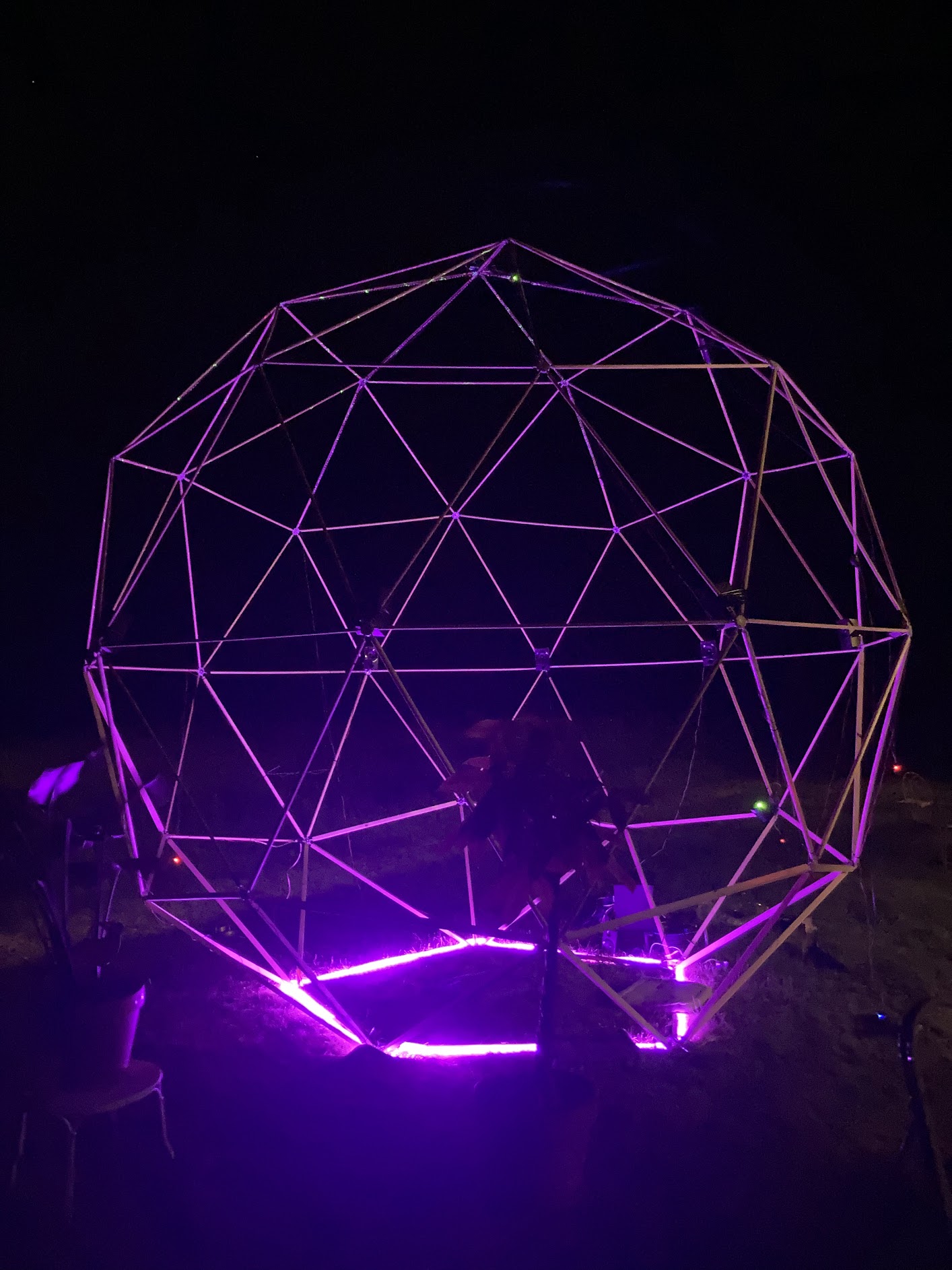
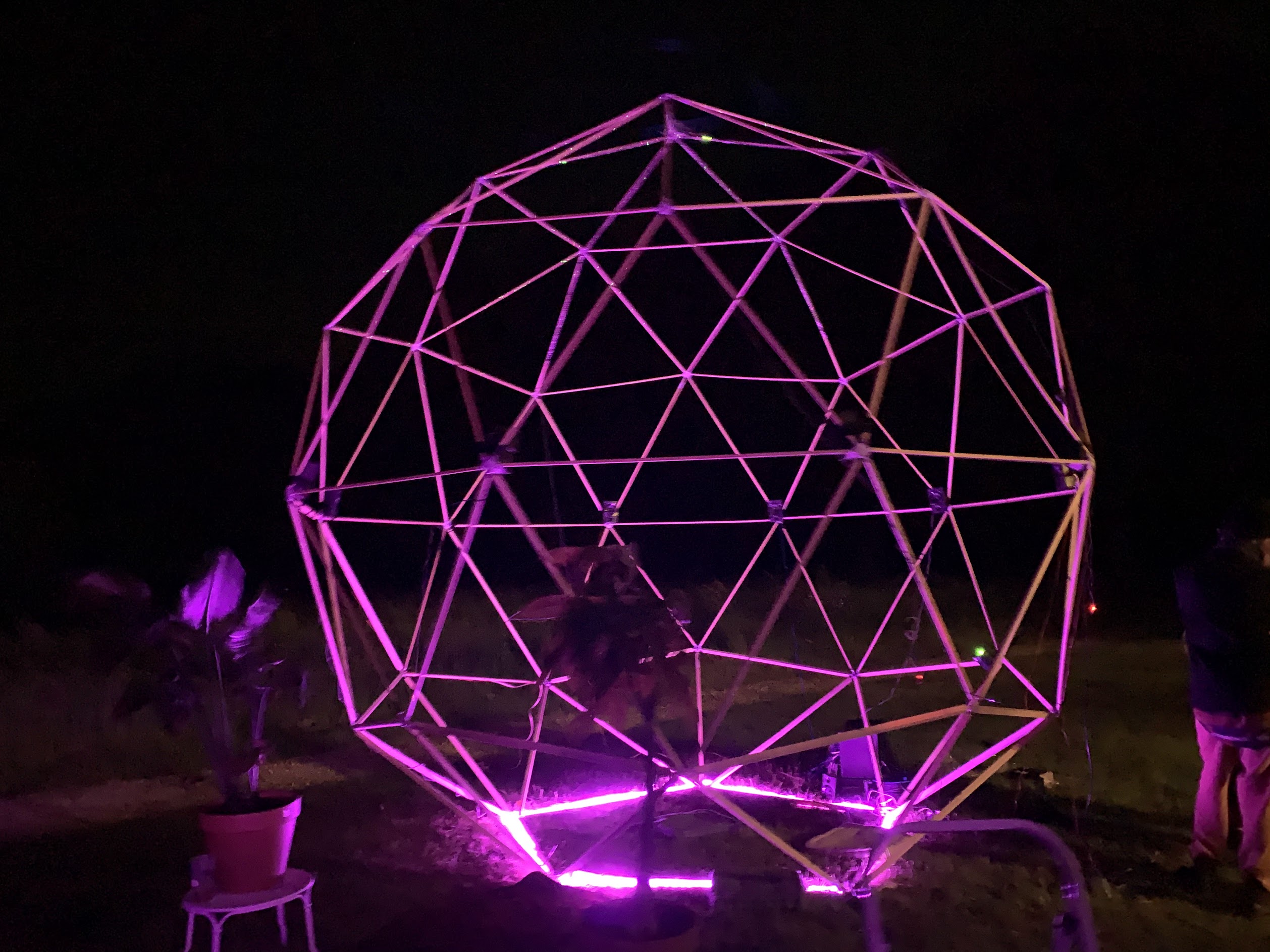
We built the dome using a very simple compact kit provided by Build with Hubs. They provided just the joins between struts, and the struts themselves we got from a hardware store for $150. They came in 50 odd 240cm round poles, and we cut them at a single point in the correct ratio to waste no wood (1179 vs 1221mm for short and long segments, if you’re interested). There’s a nifty thing on their site that helped calculate the ratio. Using two spherical domes, placed one on top of each other, we could get a fully spherical dome for $400.
Timelapse of dome construction 
The two hemi-domes joined together Speakers
Next, for speakers, we got two cheapo 5.1 surround sound speaker systems that took care of amplification and presented a total of 10 channels to address. That allowed a 360-degree sound experience, though only 2D- as the speakers were all arranged around the middle rung. On the software side, we used standard tools . All of this part was done by Tomek Smilok.
Lights
To simplify things on the light side of things, which was not our main focus, we used sound-reactive LED strips, so as sound travelled round lights were activated with the moving sound (this saved requiring programming the light by itself) and provided a glimpse of how the light can in future be super-additive to the sound. This was the work of Iannis Bardakos and friends, and involved lost of soldering.
Music
Tomek created an improvised symphony entitled ‘backpain’. Of course, till you have a Kugelauditorium in your garden, you won’t have the faintest idea of the magnificence of the experience but here’s a sense of it.
Result
Phenomenologically it felt relatively spectacular, definitely tremendously immersive and engaging.
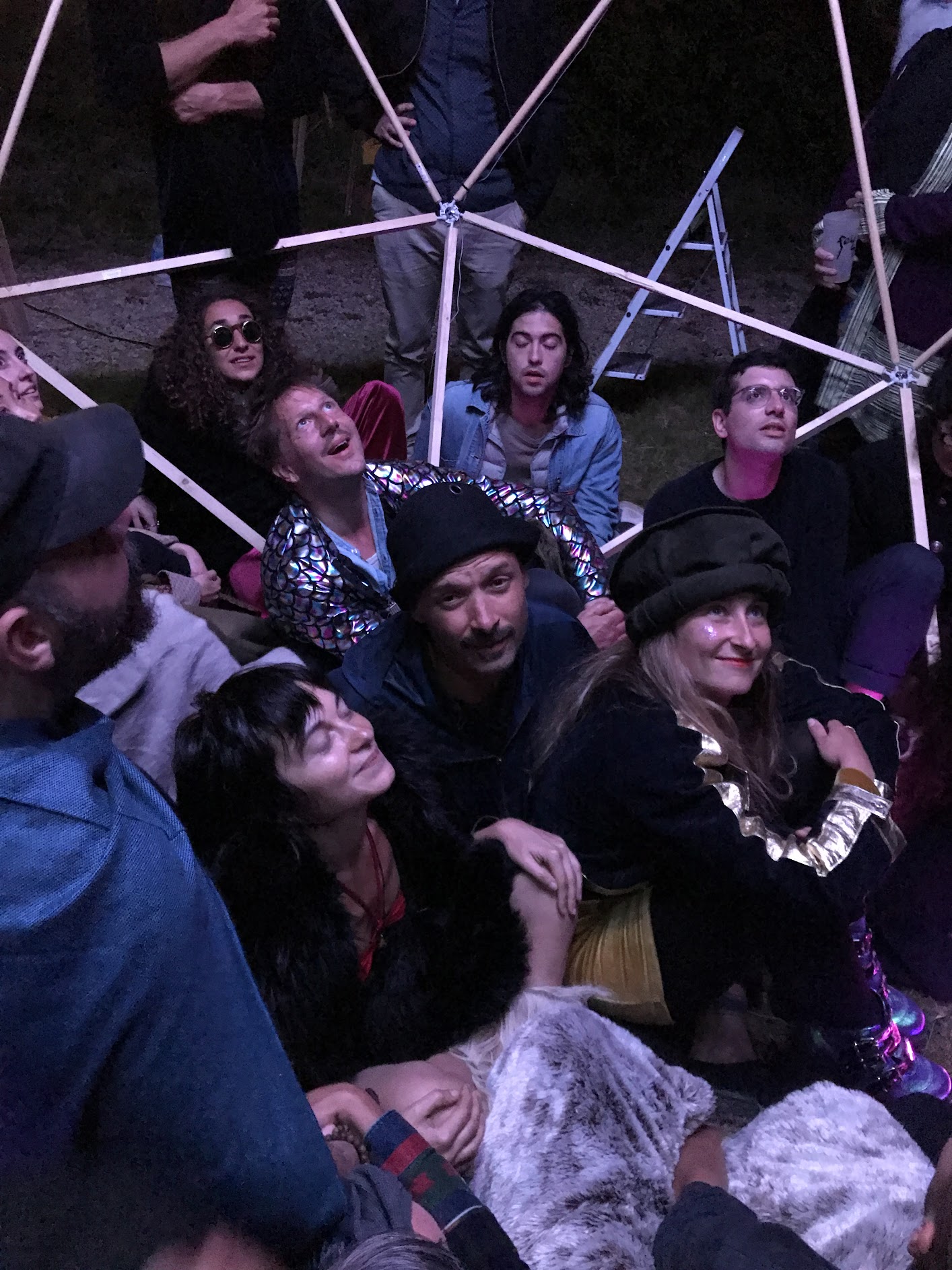
The faces tell the story of the wondrous phenomenological adventure KA2 at a distance. That was Kugelauditorium 2, (KA2) and it was pretty epic. The experience of the surround sound was great -one felt held as if a spirit in space, and it was unexpectedly comforting- I suspect the final instrument may have some pretty potent psychotherapeutic uses. Visually, the full sphere looks more than twice as cool as the generic hemi-dome, justifying the indulgence by itself, and we were able to get a glimpse of the full experience. Undoubtedly, this represents an instrument that every garden in the world should possess.
Total cost was $1200, and it took a Saturday to knock together.
Areas to focus on in KA3
We figure that a dozen or so iterations will be enough to get to something truly masterful, so we have no time lose in keeping iterating. The next prototype will be built in London in July, with the following one likely in August by Californian sound artist Sarah Stevenson.
The principal limitations in KA2 were:
- The sound was limited to ten channels and was only 2-d (360-degree surround but on just one plane)
- The positioning of people in the structure was at the bottom not in the middle
- We didn’t really have time to experiment with the music.
The key issue we’re addressing in KA3 is the first, making the sounds fully three dimensional and over many more channels, including the capacity to map the sounds to that space in software easily. We’ll also aim to develop the structure so that a person can be suspended in the middle.
—–
KA3 spec: our main project here is to make the sound fully 3-D. So we’ll use the same basic dome structure, but use stronger wood to create the possibility of a single person being suspended right in the middle to enjoy the fully three-dimensional sound immersion.
We don’t know how many individual sound channels are required for fully-3D maximal precision of audition, but because the dome structure has 42 joins (from top to bottom at the different layers: 1/5/10/10/10/5/1) and because is 42 is more than 10 and because audition isn’t terribly spatially accurate, we’re going on the basis that 42 will more than cover it, and 41 in fact since there is no lowest point. That we guess will be perceptually equivalent to having 1000 speakers in terms of spatial precision (we may be wrong about this, of course).
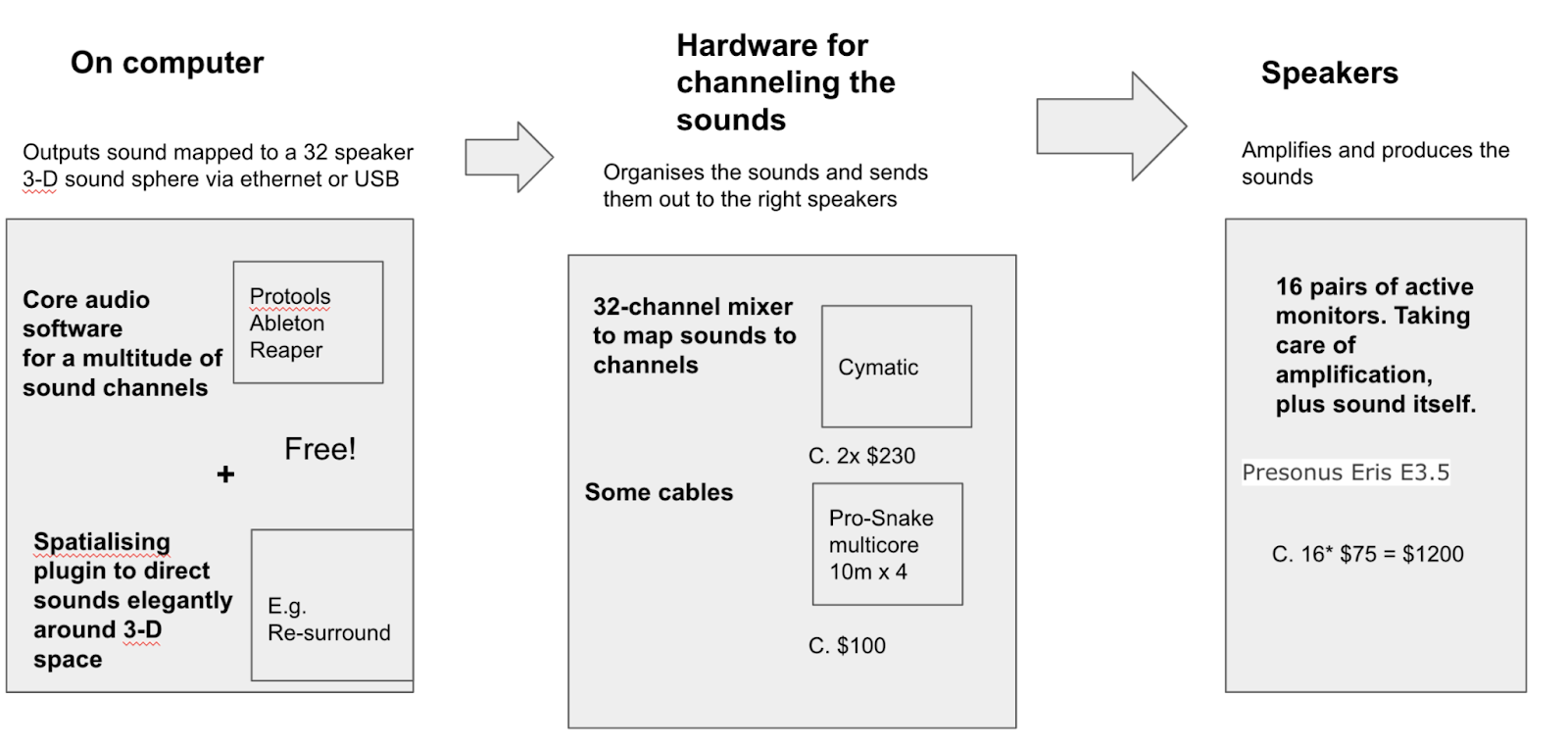
For simplicity for the next version, we’re cutting this 42 down since 32-channel audio is relatively easier to manage from a hardware perspective, so we’ll aim for that, provisionally with 1:5:5:10:5:5:1 at the different levels of the dome (or perhaps 1:4:6:10:6:4:1), and a subwoofer at the bottom to make 32.The basic diagram of the architecture is like this:
So our complete recipe for the kit (not including lights) for the KA3 will be this:
- Two geodesic dome kits from Built with Hubs (it’s cheaper to get your own sticks, but these kits including sticks are very convenient- (2* £275)
- 16 pairs of active monitors, specifically the Presonius Eire 3.5s (c. £1200)
- A subwoofer – specifically Presonius Erie Sub8 (£175)
- Loads of cables – specifically these sssnake IPP1030s (c. £100, a mix of 3m and 6 m versions)
- two multi channel DACs, specifically the Cymatics Audio live player LP16 (£215*2)- this was the most exciting piece of kit to discover, as 32-channel DACs normally set you back $3000.
So in total we get to £2300 before cost of any lights we may add. Not bad, but still touching $3000 and twice as expensive as the first prototype. We will need to build efficiencies into the prototyping process, but we should still get 12 prototypes in for the original Bitcoin which was swapped for the dream of a Kugelauditorium.
With this recipe, we can get to a fully spatialised 3-D sound and that will help us answer these questions:
- Are 32 speakers enough for fully spatialised sound?
- Does the hardware work and is it simple to set up
- What is the experience like building music in this set up?
- And are slightly thicker broom-sticks sufficient to hold a person suspended in the middle
We aim to have the prototype built for end of July, the work taking place not in Burgundy but in the crypt of a chruch in Holloway, UK, under the auspices of Merijn Royaards. The hope is that he audio hardware will be fit for purpose, and so future iterations will be able to reuse the same hardware.
I’d love to express my thanks to, among other in what was a glorious group project, Tomek Smilok, Alix Faddoul, Iannis Bardakos, and Primavera Di Fillipi for actually building the thing.
- Which is more memorable, a Bitcoin or a Spherical Concert Hall?

The Kugelauditorium, the world’s first and only spherical concert hall. Bitcoin is undoubtedly a magnificent crypto-asset, but how does it stack up to peak experiences in lived life, in its overall value?
Does the moral choice to enjoy possession of bitcoin survive consideration of the alternative possibility of creating a spherical concert hall, for example?
Though I’m very long on bitcoin (which is already at c. $50k), and therefore tempted to hoard my stash till my dying days, I am also long on the value of human experience, which I think of as the essence of the value of our miraculous existence.
This presents a specific practical question: what should I do, hoard my bitcoin or turn it into magical experiences in a spherical concert hall?
In this post I set out to decide. I’m assuming you know all about Bitcoin, so I’ll focus mainly on describing what a spherical concert hall is, on the basis of the only example that yet existed, before comparing the relative value of owning a Bitcoin vs such a concert hall.
Part 1: The short, glorious history of the Kugelauditorium
The so-called Kugelauditorium was a spherical concert hall built by architect Fritz Bornemann after a musical concept from electronic composer Karlheinz Stockhausen for the West German pavilion at the astonishing Osaka 1970 world fair. It charmed half a million people in its brief existence, but has not been re-attempted since.
Design of the structure

The basic idea of the ‘Kugelauditorium’ was, in Stockhausen’s own words, to create “a spherical chamber, with a platform, transparent to both light and sound, hung for the listeners. They could hear music coming from above, from below and from all directions.”
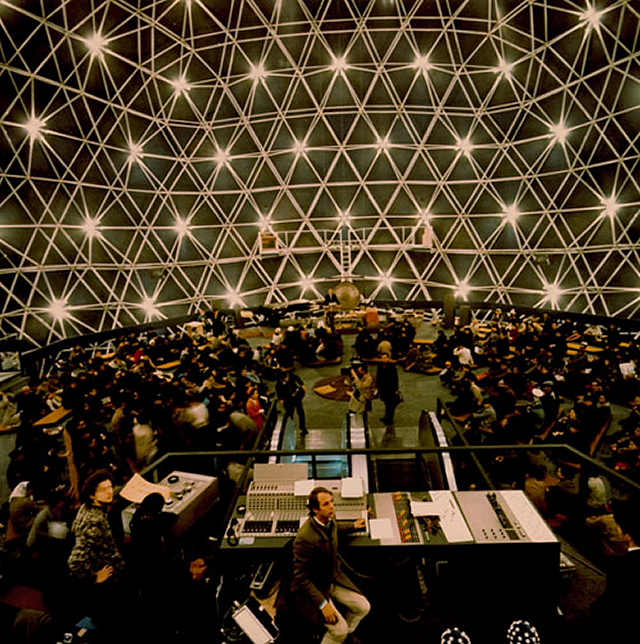
A view of the Kugelauditorium’s interior space 3D sound arrangements
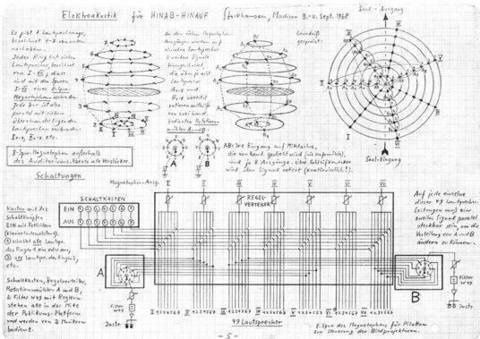
The wiring diagram of the spherical concert hall Concretely, this was accomplished with a huge spherical Buckminster Fuller Dome, in which a raised platform, transparent to sound, sat up to 500 people roughly in the middle of the sphere. A total of fifty sets of loudspeakers arranged in 7 rings allowed sound to be played from any point in 3-Dimensional space. You can see how it was wired above.

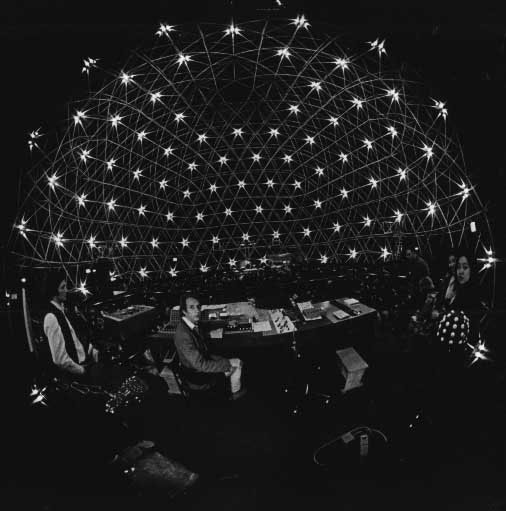
Karlheinz mixing 3-D sound in the Kugelauditorium Stockhausen is pictured above standing at the sound desk, where he could control the position and trajectories of up to ten individual sound channels, using either a ten-channel rotation mill made to Stockhausen’s spec or instead a spherical controller designed by Fritz Winckel of the Electronic Music Studio at the Technical University of Berlin .
Manipulating the sounds
The Kugelauditorium was something between a concert hall and a new musical instrument, and enabled the invention of a new, completely 3-Dimensional form of audiovisual music, one in which the content of the musical sounds and their spatial paths, accompanied by light trails, were composed together, to produce dynamic structured murmurations of enshrouding audiovisual sound.

Eyeballing a murmuration of starlings helps conceive of the possibilities of 3-D music. Audi-visual music
Though I haven’t been able to learn so much about the visual component of the Kugelaudtorium, it’s clear that the visual environment was as much a part of the music as the auditory one. Below you can see the auditorium in a state of darkness. Just imagine all the different motifs of lights-sounds flying around the interior. Just imagine how much easier and better this could be done with today’s electronics and software!
A note on audiovisual interactions in perception
Work over more than a century in multisensory integration in humans has detailed the many ways in which sight and sound interact, and their different specialities for perception. For example, sound has much high temporal resolution than vision. Three bleeps played simultaneously with two flashes of light can lead to a visual experience of three flashes, as sound dominates vision in matters of time. Spatially, though, vision is more precise than hearing, so when you see a flash in space played at the same time as a bleep, the perceived position of the bleep will be pulled towards the sound in experience.
This suggests that an experience of location in space much more precise than the spatial resolution of human sound perception can be accomplished by addition of correlated light- an extraordinary possibility.
Compositions in spherical music
Stockhausen, Zimmerman and Blacher among others composed extraordinary new compositions for this unique space.
Inscrutable, yet magnificent, Kugelauditoirum score from Stockhausen Stockhausen talking about his music Sadly it is of course impossible to re-experience this music till we build another such space.
What happened to the Kugelauditorium?
Vastly ambitious for 1970, Stockhausen’s Kugelauditorium rocked the Osaka world fair, and enjoyed more than half a million visitors.
The project was however beset by technical, social and financial issues, and never made it back to Germany, where it had been constructed; instead, it fell into ruin, and in the fifty years since its heyday no further attempts have been made to create such a spherical concert hall.
Overall, it seems to me to be a first attempt at a potentially outstanding genre of musical experience. Is there any town or festival in the world that wouldn’t appreciate the play of a contemporary version of this instrument? Is there a composer who wouldn’t light up at the chance of creating for this medium (assuming the right tools). Is there a festival goer who wouldn’t love to chill to whatever, say, Nils Frahm or Jean-Michel Jarre could cook up? It seems unlikely.
It’s thought provoking indeed to look at some of Jarre’s audiovisual work, for example this from Notre-Dame cathedral:
Part 2: Financial vs experiential capital
There’s a serious question that all of us implicitly answer through the living of our lives, that is much more general than the one I’m posing here, which is roughly: to what extent should we value experiences over things? Or alternatively, what is the relative value of financial vs experiential capital?
There are many ways we can come at this question, and I’d be very interested to hear other frameworks. But given the (perhaps illegitimately binary) choice: which would you rather possess, some bitcoin or a spherical concert hall, I come at it by thinking of which of how the two rank in terms of their uniqueness, perceptibility and generosity.
Implicitly, I’m saying that we should optimise in this world for these three elements.
a) Scarcity of bitcoin vs spherical concert halls:
There are 21 million Bitcoin VS zero spherical concert halls.
On this front, it’s clear the concert hall wins. There have been zero examples of this form of Being in the last fifty years, whereas 18 million bitcoin have already been mined, even if no more than 21 million ever will.
Overall, though, the world is awash with Bitcoin but entirely lacks any spherical concert halls.
So the spherical concert hall clearly wins here.
b) Perceptibility of bitcoin vs spherical concert halls:
Perceptibility is important, because all consciousness derives from perception (cf Merleau-Ponty).
Bitcoin actually put a heavy weight on perception – albeit indirectly. So bitcoin owners ten frequently to Google the price of their asset, and look yearningly at the prices from half a decade ago etc. These experiences are of low quality, linking mainly to avarice, and not challenging or inspiring the perceptual systems.
The Kugelauditorium, by contrast, is perhaps the greatest object of perception invented in the 20th century: challenging, bending and stimulating the senses in astonishing, transformational ways.
Again, the spherical concert hall wins.
c) Generosity of bitcoin vs spherical concert halls:
While Bitcoin can in principle be given away, its sky-rocketing value disincentivizes spending it, let alone donating it. Meanwhile, sadly, your bitcoins make your friends unhappy as they all wish they had this chancey asset to their person instead of you. Their lives are diminished by your luck.
Bitcoin is, then, a zero sum game, at the individual level. If you own a bitcoin, that means that somebody else doesn’t. It is at best non-generous, and at worst an act of avarice, to actually own one.
By contrast, everyone will obviously want to hang out in your Kugelauditorium. It is by nature a shared social space that purveys to its occupants riches from the outer frontiers of what is experientially possible in the human mind. It is inherently a generous concept.
One might also consider electricity consumption. The total bitcoin network usage is as much as 121 terra-watt-hours. If we divide this equally between the c. 18 million bitcoin in existence, each existent bitcoin consumes roughly as much energy as a house in the US (7 MWhrs).
This is quite ungenerous to a struggling planet. But the energy consumption of future Kugelauditoria may be similar, so on this sub-point it is a draw.
But overall Kugelauditoria are inherently much more generous.
Conclusion
Looked at through these lenses, it’s better to own a spherical concert hall than Bitcoin. I have therefore liquidated by Bitcoin holdings to fund the creation of a second Kugelauditorium.
The task of creating the second Kugelauditorium with contemporary materials, electronics and software is spine-tinglingly laden with possibility. It should be orders of magnitude easier, cheaper and more elaborable building a spherical concert hall now than it was 50 years ago. I expect that we may be able to create something relatively astonishing.
Since I have no idea how to build anything, I have created this form for anyone who wishes to help.
The main areas where we can anticipate the need for help to begin with are:
- Design / construction of geodesic dome
- Rigging of speakers and lights
- Electronics for pushing the light-sound around the sphere
- Software to enable speedy creation and sharing of audiovisual compositions
- AI programs for translating existing repertory of music into audiovisual 3-D sound.
Once again, do please sign up to help here.
We have a preliminary spot in Burgundy for building the first Kugelauditorium; the intent is to open-source the designs and findings in the hope that every town around the world, or at least one other group, will eventually build one for themselves.
- Taking Burning Man Online with the Sparkleverse.
Burning Man is Going Online
To many of those who co-create it every year, Burning Man isn’t just the best party in the world, it’s the best place in the world. For the sole purpose of the experience of doing so, seventy thousand people engage in the pleasurable inconvenience of conjuring an ephemeral city in a desert, and collectively then live almost every aspect of human existence differently therein: home, friendship, food, architecture, time, connection are all re-invented and re-experienced every year at Burning Man. As gatherings go, Burning Man is the most all-encompassing, philosophical, and real.
This year of course, the Burn has moved online, something that presents a legitimate opportunity for skepticism to anyone who has been to the ‘real’ thing.
Indeed, the idea of an online version seems at first blush wholly far-fetched given how the regular embodied experience would seem to be almost the logical opposite of online social experience as we know it: it is after all the distance from interruption, the freedom from surveillance, the transcendence from the wretched seniority of seeming over being on social media, the sense of a pause in the everyday run of things that permits the participants of Burning Man to open up and live in full-bore openness to each other, in freedom from the banalities that dominate their everyday consciousnesses.
It demands simply an act of collective imagination
But Burning Man is and always has been an act of collective imagination. And imagination is a human attribute that doesn’t evaporate when we interact with computers. To certain of us, then, the online burn presents an opportunity to re-express the magic of Burning Man in a new medium, not to mention a wonderful opportunity to connect and experience joy in these dubious times.
BM org have seen this too, and with the luck of already having themed the 2020 Burn as the Multiverse, invited a handful of teams each to create a ‘universe’ in this ‘multiverse’.
The Sparkleverse Recipe to Bring the Burn Online
We at Sparkleverse are one such team. Having experimented with 9 online parties at scale during the lockdown within the CoReality Collective (the learnings from the first of which can be found here), we have a particular philosophy and perspective on the possibilities of experiential profundity that a mixture of active participation and the right kind of technology can accomplish. We believe the online Burn can be just as real as the physically colocated version. And we’re keen to facilitate anyone else who is ready to believe similarly in participating in and enjoying this years’ Burning Man.
To share our thinking, and perhaps to inspire participation, this is a sketch of our design thinking and approach for the online Burn. There are twelve core features we have implemented and which stand ready to go.
1. Simple, accessible web technology

Unlike the rest of life, Burning Man apsires to radical inclusion. Anyone and everyone is welcome. When on the Playa, nobody cares who you are in ‘default reality’. As an aside, this has a quite unexpected experiential status (freedom from status and prejudice, that only goes to reveal how regrettably potent and all-encompassingAnd while there are certain geographical, financial and logistical inconveniences associated with attending that mean that at the actual burn West-coast affluent Americans are rather too generously represented, the spirit of the place could hardly be more welcoming.
This is one of the aspects of the Burn, So in designing the Sparkleverse, we aimed for maximal accessibility (ubiquitous web-based technology) and the simplest possible ways to create in the space.
2. Potent tools for space creation

The astonishing and distinguishing feature of Black Rock City is that it is built each year by its participants from scratch in the salt-pan of a harsh and featureless desert. (The same is true of the real world, if only with a more historic time-scale). As one wanders around BM, it is this subtext- that everything you see, despite its ambition and magnificence, is built without supervision by the very participants among whom you are roving,- that lends every moment of lived existence therein a certain joyful inclusiveness: “we built this”. Rather than being a mere spectator, one has
It is this radical participation, entirely decentralised, entirely welcoming to all and every flavour of creative impulse, that is internal both to the magnificence of what results, and it to its felt significance. Because anyone who can build may do so, the results is the unihibited creative expression of the widest possible diversity of consciousnss, given the participants.
So we have created tools that allow anyone to open up a space.
3. An explorable Playa level

The Playa in physical Burning Man is an immense space seven miles wide, with a horseshoe of camps accounting for the city suburbs, and the wide open desert Playa the equivalent of the nearby countryside or park space. This fearsome desert space is the receptacle for all the fun that then takes place, once populated with all the art, camps, etc etc.
For online burn, we wanted to retain the iconic horse-shoe and overall layout, while adding a Sparkling diamond trashfence- a fence that encases the whole., which acts both as a border and as a trap for any wind-strewn matter-out-of-place (moop).
There will be two methods of navigating this Playa. The bird’s eye view mode, which will allow people to hover over it, clicking into whichever experiences they please. And True-Burner- mode, where you will be placed with video avatar and ambient audio on the Playa and pootle around at locomotory or bicycle speed – more of which later.
4. Camps

Because you live in the desert for a week at Burning Man, where and how you camp plays a key role in the constitution of your experience. Camp at the burn is mostly where you sleep, where you eat, where you build, where you host, and where you experience the most engaged community. It is the power of collaboration in camps that gives rise to some of the most delicious shared experiences, and camps are often the kernel of real-world communities who come back year after year.
For our digital camps, we allow people to add a second-layer map ‘beneath’ the Playa, which people can click through to from the Playa. On this second level map, Camp creators can then arrange a set of images that each lead when clicked upon to a . You can see how many people are within each of the rooms in a camp, and enter any of them by clicking.
People will be able to sleep in digital tents in their camps, and more generally camp will be a place to which digital burners retreat to chill with their friends before another sortie into the indeterminate adventures available on the broader Playa.
5. Art pieces

Alongside (and indeed within) camps on the Playa, Art pieces and performance venues are part of the necessary ornaments of the Playa.
When you encounter an art piece, you can click through to a special space featuring an embedded iFrame of any web experience, accompanied with video chat so you can talk with your fellow burners as you admire the art- the source of many a fine encounter at the actual burn. There will also be information about the art and a message board to leave thoughts and admiration.
6. Performance spaces

So much of one’s experience at Burning Man is in encountering spaces constituted by their human presence: not just something. to view, but a social world to interact with. Unlike the contemporary web, these experiences are *hosted*- actively shaped live by the behaviour of their creators and participants.
Performance spaces in the Sparkleverse are mediated by Zoom rooms. Don’t worry, this most banal of business tools can be made to sing with the right technique (see the Sparkleversity, whose function is described below.) They will include anything and everything, from comedians, DJs, philosophical discussions, interactive mermaid shows, workshops in yoga/ mindfulness/star-gazing/origami and any of the other myriad things that imagination will bring forth.
7. Pleasurably inconvenient entry

One way of understanding Burning Man is as a sequence of experiences that gradually distance the participant from the preoccupations of their everyday life. Loss of contact with default reality is accomplished as much by the journey to, as the contents within, the burn. In this, the road trip out from, say, San Francisco or Mexico City, is a key part of the experience.
There will be two ways to onboard into the digital Playa. The first is excessively convenient: you just go in. Heroic mode, by contrast, will replicate to some small extent the experience of a roadtrip to the burn. You’ll be put in a car for an hour (we were talked out of 8 hours because it’s ‘not feasible’) with three other burners. You will then be in a time-locked capsule where the only thing to do is watch the cactuses going by and the diminishing count-down timer, and chat to the fellow occupants of your virtual vehicle.
Besides the company you keep it will be boring of course, but it won’t be boring of course because you will be gleefully making new friends, building anticipation and feeling the claws of everyday life gradually slipping away from your consciousness as the great wide-open reaches of its potentiality begin to open up.
8. Digital camping

During onboarding, everyone will have to make a choice about their specific bedding arrangements. A choice of RV, Hexayurt, Kodiak tent or standard tent: for all their creativity, burners have their preferred ways of living.
Your tent will then find a space in camp or on Playa. It will have space for up to four occupants. It will be lockable, so as to create space for intimate sharing and goodness. We recommend people sleep inside their tents with computer on- so they can be woken by friends who’ve come to find them to advise them of some exciting happening the missing of which sleep can be no excuse.
9. Serendipity on the Playa

While we will reluctantly permit a “bird’s eye view” mode in travelling the Playa, this has the limitation of lacking limitation. In the physically co-located Burn, when you encounter someone on the outer edges of the Playa, they haven’t just clicked to get there. You both won the right to a sense of joy at the mere fact of interacting with each other because by necessity you committed an hour of their life to cycling or wandering out there.
So heroic mode will see you constrained to human speed on the Playa, with a little video avatar, and ambient audio. What you give up in convenience you’ll more than make up for in the joys of encounter. Often it is during this journeying interspace that the most magic encounters happen.
10. Live schedule, with pot luck button

When I went to Burning Man for the second time, I was surprised and disappointed to realise that a schedule existed, which seemed to contrary to the spirit of anarchic discovery. Yet my prejudice has since mellowed: some burners embrace the schedule, informing themselves of magic happenings and zipping around the Playa to intercept them. So we provide easy access to a “what’s on now” and schedule to allow this technique to find effective expression.
While there is a schedule for burning man, the decentralised immensity of creativity often means that there is also call for a “pot luck” button, where you’re simply thrown into the next experience without any awareness of what it is. (See also ‘Dust storms’ below for another example of designed vulnerability to what happens next).
11. Digital costumes

It is a matter of great intrigue in human affairs, the power of the costume. The act of dressing up has tremendous effect on consciousness. Dressing up can reframe how we think, feel, act and perceive. Unlike a 3-D avatar, it also holds space for our face and eyes, for who we are. It is this mixture that makes augmented video, not 3-D avatars, the path to ‘virtual reality’.
And so goes that at parties, dressing up is an act of generosity both to self and to other. To the self, it garners freedom: it allows us greater motility in exploring fresh facets of our potentiality. When others see us in costume, they are likewise freed up from the preconscious prejudices and habits that suck the potential from most everyday interactions. So costume is a vastly important piece of. This is best done by physically dressing up, but even then there is an important role to be played by digital costume.
This is where Snap filters come in (and to a more banal extent, zoom backgrounds). We have SNAP to thank for arguably the most joyful approach to technology in the contemporary tech-o-sphere. I for one thought that when they IPO-ed claiming to be “camera company” that we were being treated to vacuous salesmanship, but I was wrong: snap filters are the source of digital costumes of the very best quality. And with Snap Studio 3, we are.
So we’ll be creating lotsof costumes for this digital world, and we encourage you to do so too. There’ll also be digital costume making workshops in the digital realm.
12. Mixed reality spaces

A little analysis reveals that the fundament of conscious experience- the human body- is just as real in the event of an online Burn as it would be at a Burn on the Playa. It’s just that the bodies are spatially separated (even if they remain temporally unified).
Nonetheless, leveraging the immediate physical world is an important aspect of the Sparkleverse product at its best. So we are encouraging performers and artists to have their co-participants leverage their immediate environments a bit like physical costumes to help amplify their sense of immersion.
At CoReality parties we have had great success with mixed reality hot tubs for example, where everyone runs and enters their baths while placing their device on a well positioned nearby chair so they can have the sensory experience of sharing a hot tub at a distance.
These kinds of experience will be numerous in the Sparklever.se.
13. The Sparkleversity

Burning man is created by its participants, and since this is the first time it has been attempted online, there is call for a resource of shared materials to educate, inspire and animate the sense of capability and participation of those who fancy taking part.
So you can find the Sparkleversity here.
14. Heroic stats and achievements
For the most part, Burners have the impression that they are heroes. This impression is accurate. The mere fact of survival on the Playa, a desert lacking any native resources for survival such as water and with brutal temperatures (both hot and not at all), excites people to embrace quite unusual levels of physical exertion. One experiences hunger, thirst and tiredness in new and powerful ways that collectively animate the body, in turn leading to an amplified capacity for pleasure and perception.

For the post part, this element of proceedings will require mixed reality participation (cutting off water supply in your flat, participating for long periods of time, eating only when back in camp), but we help this along on the product side by letting participants know when they’ve done noteworthy things such as each milestone of 12 hours spent on Playa. Serious burners will do the whole 192 hours.
By making these achievements public on their profile, alongside the list of all camps visited, the infectious heroism of others may inspire all burners to new heights of participation (as well as providing a new vector of discovery).

15. Burning Man Information Radio

To those who Burn each year, Burning Man Information Radio provides a joyful accompaniment to the adventures around the Playa. Listening to this very diverse and amusing station gives a sense of presence and community across the immense distant reaches of the Black Rock party universe, amounting to a form of ambient emotional perception, which one often pipes into the brain while manoeuvring around the hot sands.
So we’ll be providing access to this marvellous radio station from our top-bar where the whimsy and magic of what’s going on not just in the Sparkleverse but across the Multiverse can provide a sustaining accompaniment.
16. Dust storms

In much of human life, we have the illusion of mastery. But in fact, our being and our consciousness are the emergent property of our interaction with the environment: we are vulnerable to the world, it pipes into us and constitutes us.
At Burning Man, an important feature of the overall experience is the occasional and unheralded dust storms that obliterate all visibility and hound the skin with a rough sandy pasting. When such “white outs” strike, the burner scrambles desperately for the nearest hiding place. This is a great source of positive ‘noise’ in one’s path through the Playa, as the scramble to the nearest place and the sense of being safely enshrouded often gives rise to rich and unexpected moments of connection.
Thus, at random, a digital sand storm will power across the Playa rendering useless all navigational devices / schedules etc. You will have one option and one option only: to head to the nearest space and hang out there for the duration of the sand storm. A wonderful chance to meet interesting people.
17. Gifting

There is no money at burning man, and the power of this absence is difficult fully to appreciate until experienced. It takes a day or three fully to adapt to interactions with other people entirely unmediated by commercial interests. One just receives and gives, without expectation that one such act should beckon another.
In the Sparkleverse, it will be possible to send digital gifts to other burners via their profiles.
18. Portals to other universes

From a first person point of view, Burning Man is staggeringly scale-agnostic. That is, as you manifest your personal journey your consciousness will be occupied entirely at one point by the smallest thing -a tiny gift for example- and the next point by the largest – an immense art car, or the the burning of a vast 100m high Man. And the one is equal to the other.
In this way, the experiential tapestry of the whole is fractal: you pass through one experience into the next and it always feels like a continuous progress forward regardless of what it is that currently colonises your mind.The Sparkleverse is only one of several universes that together make up the multiverse. And we want to encourage people to flow as freely as possible through the tapestry of the mulitverse. For this reason, prominently on our Playa there will be portals. to other universes through which one can pass back and forth in unfolding the grand extravagance of digital inventiveness being manifested across this seminal happening.
19. The burning of the man

It would be remiss to reveal how we have imagined the centrepiece, the epic coming together that acts as the conjoining mnemonic and experoential landmark of each burn, a . of the whole. But imagine it we have, and we can’t wait for you to experience it first hand.
How to get involved
Build week is just beginning at this moment (August 23rd, 2020). There is plenty of time to get involved. We welcome you to add whatever you wish to add to the Sparkleverse. This will with luck be a seminal online happening, bringing together people from around the world in an act of co-participation and joy that can energise. To go ahead and create something, go here. To educate yourself about how to go about doing that, you can sign up for a webinar here.
The Burn itself is August 30th-September 6th. You can get tickets here. They are donation-based, and on sale now.
If you have any questions, please check out our FAQ or be in touch here.
- Memorable dreamsReading Time: < 1 minute
It isn’t just because our dreams are more interesting than our actual lives that they’re so worth remembering. There’s a further advantage: detailed dream-memory fosters the understanding that can enable us to recognize our dreams as they occur. If we can do that, then we can have the pleasure of taking control. And lucid dreaming, as this is called, is about the most entertaining private activity known to man.
What makes dream-recall difficult is the way memories are stored in contexts. To recall a memory, we re-activate the state we were in whenwe first stored it. If you learn something when diving after jellyfishwhile wearing a false moustache, for instance, you’ll recall it best when re-submerged, re-moustachioed and back chasing the jellies.
The problem with remembering dreams is a kind of Catch 22: you’re either in a dream-state, and therefore too asleep to be doing any remembering; or else you’re awake, but outside the dreamy context where dream-memories cluster. To escape this bind requires tactical nous: you need to begin your dream-recall before your dreams have entirely finished.
Fortunately, our dreams are very punctual: they tend to fit our sleep schedules exactly. So by setting your alarm as little as ten minutes earlier than normal, you can reliably wake during a dream, not after it. Here is your opportunity: it takes a few moments fully to exit dreaminess. Get recalling with pen and paper during this period, and you’ll be thrilled with what you can remember.
And by practicing dream-recall like this daily for three weeks consecutively, you’ll find an almost surreal extension to your powers of recollection. You’ll remember multiple dreams- and in astonishing, filmic detail. Why such improvement? Because you’ll have come to understand the thing you’re seeking, you’ll know the quirks and foibles of your dreams.
This honed sense of their characteristic style will then allow you to spot your dreams for what they are- when you’re inside them. While dreaming, as you get down to installing a swimming pool in your E-Type Jag, or whatever, you’ll no longer find it it all very sensible, as one generally does. Instead, you’ll think to yourself “this sort of nonsense happens only in dreams”. Such a realization will allow you to draw the conclusion “this must therefore be a dream”. And once you know that, you can begin exercising control.
The delights that follow are up to you.